


Arm ($ARM) delivered a strong start to Fiscal 2027, but I don’t think the results justify its current valuation. Arm licenses energy-efficient central processing unit (CPU) architectures and chip designs, collecting royalties whenever its customers ship chips. That business gives it exposure to smartphones, cloud computing, and increasingly artificial intelligence (AI) infrastructure. The long-term opportunity is real, especially as Arm expands into AI silicon.
Even so, I believe today’s valuation already prices in much of that potential, leaving me bearish on ARM.

Q1 Delivered Nearly Everywhere
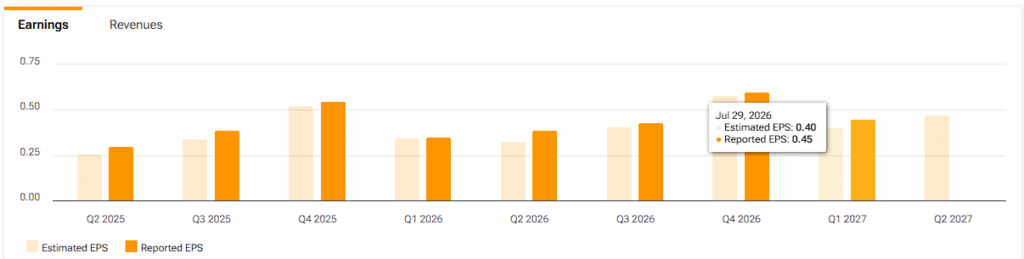
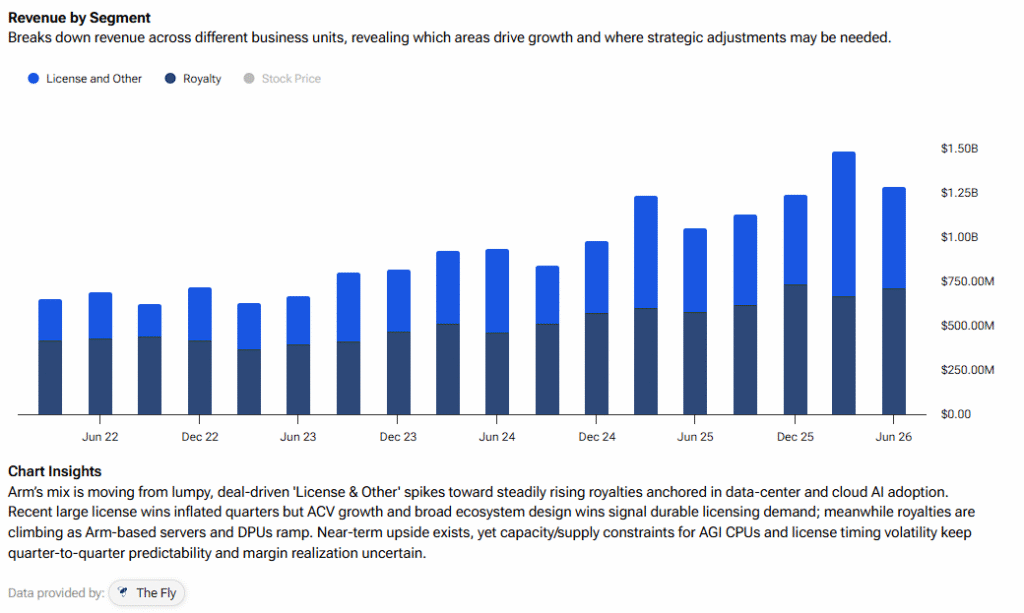
Arm’s Fiscal Q1 results delivered nearly everywhere investors would have wanted. Revenue reached $1.29 billion, up 22% year-over-year and modestly ahead of the $1.26 billion consensus. Adjusted earnings per share (EPS) increased 29% to $0.45, beating the $0.40 Wall Street expected. This was no one-line result, either. Royalty revenue rose 22% to $715 million, while license and other revenue advanced 23% to $574 million.
The royalty performance was the more exciting part. Data-center royalties more than doubled as Arm-based processors gained ground, while adoption of Armv9 and Compute Subsystems lifted the royalty collected per chip. Neoverse shipments have now passed 1.5 billion cores. Remarkably, the latest 500 million were shipped in nine months after the first billion took six years. Licensing benefited from several large renewals and customers securing access to Arm’s future roadmap.
Still, annualized contract value grew by a slower 13% to $1.73 billion. That was a good reminder that quarterly licensing revenue can be lumpy.
Profitability looked excellent on Arm’s preferred measure too. Adjusted operating income grew 29% to $531 million, and its margin expanded from 39.1% to 41.2%. Revenue rose 22% while adjusted operating expenses grew 18%, with selling and administrative costs increasing only 13%. Therefore, we saw genuine leverage there. Yet GAAP operating margin moved the other way, falling from 10.8% to 7.1%, as reported operating expenses rose 28%.
Growth Could Accelerate from Here
Growth may actually pick up from here, especially once revenue from AGI CPU, designed to meet demand for agentic AI, begins to show up in the numbers. Consensus estimates currently call for about $6.05 billion of revenue in Fiscal 2027, an increase of roughly 23%, followed by a much stronger 36% rise to $8.21 billion in Fiscal 2028. That acceleration is plausible.
Arm has already secured enough capacity to support the planned $1 billion AGI CPU opportunity over those two years, while indicated customer demand has now exceeded $2 billion. In other words, demand does not appear to be the constraint. Additional capacity could allow Arm to close more of that gap and convert a larger share of the opportunity into revenue.
The existing Intellectual Property (IP) business has strong momentum, too. Nvidia’s ($NVDA) Arm-based Vera CPU has entered production, and AWS ($AMZN) has agreed to deploy tens of millions of Graviton5 cores at Meta ($META). Google’s ($GOOGL) Axion and Microsoft’s ($MSFT) Cobalt are further evidence that hyperscalers increasingly value Arm’s performance per watt. As AI inference scales, CPUs still have to coordinate data movement and run the general-purpose work surrounding accelerators. Arm therefore participates in AI spending without needing to displace the graphics processing unit (GPU).
Also, Arm is unlikely to see the sudden revenue spikes that some AI hardware suppliers, like semis, enjoy when capacity is scarce. Its royalty comes only after customers begin shipping chips, so design wins take a while to feed through. Phones are not helping much either. Management now expects royalty growth in the high teens, below its earlier 20% target. This is partly because high memory prices are weighing on handset demand.
Faster AGI CPU supply, a richer Armv9 mix, or a phone recovery could help, but none makes hypergrowth a given.
The Valuation Still Looks Detached
My biggest issue, however, is that the valuation still looks detached despite the pullback. At about $239, Arm trades roughly 47% below its 52-week high. However, the stock still commands around 107x the current fiscal-year EPS consensus of $2.23. That leaves ample room for another decline, even if the next few quarters are good. At this price, merely meeting a 20%-plus growth outlook may not be enough.
I understand why investors grant Arm a premium. Its Q1 GAAP gross margin was an extraordinary 97.2%, so additional IP revenue can produce considerable operating leverage once engineering costs grow more slowly. The architecture is embedded in more than 350 billion shipped chips, and 22 million developers support the ecosystem. Those numbers describe a great moat.
There is a catch, however, as AGI CPU revenue involves manufactured silicon, not pure IP. It is therefore unlikely to carry the same gross margin.
Also, the adjusted numbers make profitability look better than it really was. Arm posted just $91 million of GAAP operating income in Q1, down 20%, while $128 million of its $270 million net income came from equity investment gains. Stock-based compensation (SBC) jumped 42% to $343 million, or nearly 27% of revenue, and diluted weighted-average shares rose from 1.065 billion to 1.078 billion. The dilution is manageable, but it keeps adding up, and at more than 100x adjusted earnings, it is hard to ignore.
Is ARM a Buy, Sell, or Hold?
Despite its lofty valuation, ARM stock continues to boast a Strong Buy consensus rating on Wall Street. This is based on 19 Buy ratings and six Hold ratings. No analyst rates the stock a Sell. Further, ARM’s average price target of $290.09 implies about 21% upside potential over the next 12 months.

Final Thoughts
ARM may indeed deliver the growth Wall Street expects. In fact, it may even do better. My issue is that the stock already assumes the AGI CPU ramp goes mostly to plan. It also assumes margins continue to improve and dilution does not become a bigger issue.
Investors are also giving Arm a lot of credit for maintaining its grip on the ecosystem. Maybe that proves fair. However, at this price, even a fairly small setback could hit the shares hard. I still see more downside than upside.
